Table of Contents
Key editorial subdivisions and topics reviewed in this report.
Strategic Federal Grant Bolsters Okanagan Air Gateway
Direct federal funding addresses long-term commercial passenger growth and regional air connectivity across British Columbia's interior.
Transport Canada has confirmed an $18.4 million capital injection for Kelowna International Airport (YLW) through national transportation infrastructure initiatives. The funding arrives as passenger movements across the Okanagan Valley surpass pre-pandemic benchmarks, placing heightened demand on terminal processing lanes, apron parking stands, and primary pavement integrity.
Local airport authority executives and municipal leadership emphasized that dedicated funding bridges a pivotal financing gap for multi-year capital renewal. The planned airfield interventions ensure regional hubs maintain stringent commercial aviation safety standards while preparing for larger gauge narrowbody operations.
Modernizing airfield pavement surfaces and processing infrastructure ensures YLW continues to serve as an indispensable commercial engine for British Columbia's interior communities.
Engineering evaluations completed earlier this year identified critical sub-base stabilization requirements along primary runway thresholds. Federal involvement expedites phased construction without interrupting scheduled passenger operations or air cargo distribution networks.
Airfield Overhauls and Operational Resilience
The infrastructure plan prioritizes structural resurfacing, taxiway realignments, and enhanced navigational guidance systems.
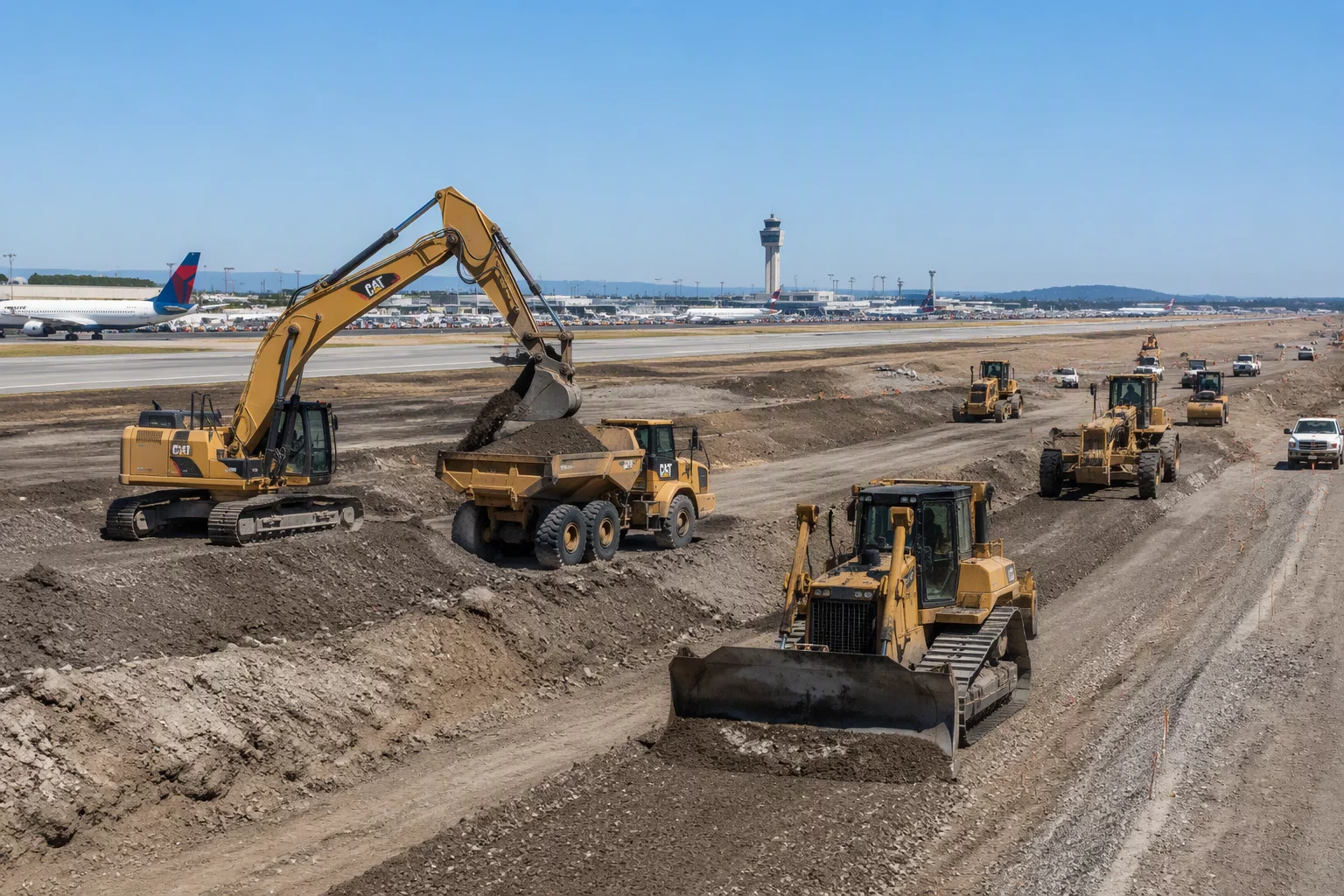
Airfield safety remains the centerpiece of the modernization blueprint. Construction crews will deploy specialized asphalt compaction and advanced surface grooving across Runway 16/34 to improve friction coefficients under extreme winter operating conditions.
- Complete mill-and-overlay paving covering 8,900 feet of primary runway surface.
- High-efficiency LED centerline lighting and upgraded Category I Instrument Landing System (ILS) sensors.
- Expanded rapid-exit taxiway Alpha to reduce runway occupancy times during peak arrival banks.
Ground operations will also benefit from widened de-icing aprons and reinforced holding bays capable of accommodating Airbus A220 and Boeing 737 MAX aircraft concurrently.
Terminal Capacity and Long-Term Okanagan Growth
Expanded passenger departures and automated baggage screening support broader tourism and supply chain integration.
Beyond airfield civil works, a portion of the capital envelope supports phase two of the YLW terminal expansion. New security screening lanes equipped with advanced computed tomography (CT) scanners will streamline passenger flow, while expanded gate seating directly reduces terminal congestion during winter holiday surges.
Regional trade associations and airline operators have welcomed the investment as a decisive catalyst for the interior economy. Sustained passenger throughput strengthens supply lines for high-value Okanagan agricultural exports and guarantees dependable medical transport links to Vancouver and Calgary.
Related Dispatches
Further reporting and operational developments across Canadian regional hubs.
Editorial FAQ
Frequently clarified aspects regarding this sector analysis.
Reader Analysis & Comments
Share verified operational perspectives and regional air transport observations.
No comments yet. Be the first to leave a comment.